Welcome to Our Website!
Add your email below to get updates!
The Environmental Impact of Nitrogen Trifluoride (NF3) in Semiconductor Manufacturing
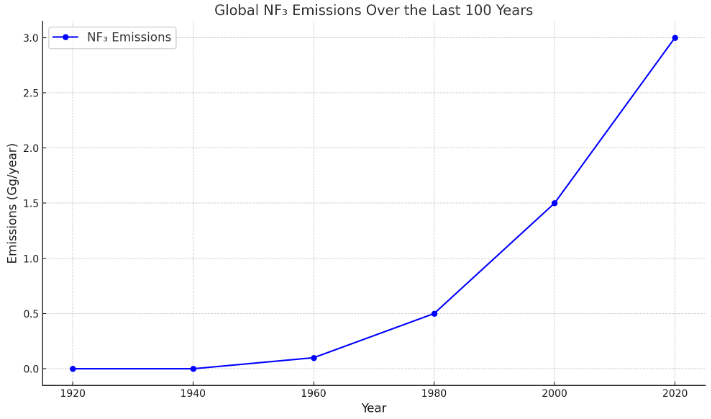
Nitrogen trifluoride (NF3) is a potent greenhouse gas, with a global warming potential significantly higher than carbon dioxide. Primarily used in semiconductor manufacturing, NF3 is an important concern for the tech industry, particularly as demand for electronic devices continues to rise.
Despite its relatively low atmospheric concentration, NF3 is a powerful greenhouse gas, and its long atmospheric lifespan means that emissions today can impact the climate for many years. Addressing NF3 emissions involves improving manufacturing processes and exploring alternatives that minimise its release.
Moreover, awareness and education about NF3's environmental effects are crucial for driving change within the industry. As technology evolves, efforts to mitigate the impact of NF3 must be prioritised to promote sustainable practices in electronics manufacturing.
Key Messages
-
NF3 is a potent greenhouse gas.
Its warming potential far exceeds that of carbon dioxide. -
Used mainly in semiconductor manufacturing.
Rising demand for electronics increases concerns about NF3 emissions. -
Long atmospheric lifespan amplifies impact.
Emissions today can affect the climate for years to come. -
Sustainable manufacturing practices are essential.
Reducing NF3 emissions requires improved processes and exploring alternatives. -
Collaboration drives effective solutions.
Industry and policymakers must unite to minimise NF3’s environmental impact.